
The Research Behind Prediction: Our Work in INMR
What 21 pages of field data say about catching insulator failure before it becomes an outage or an ignition.
INMR is where the transmission and insulator world goes to read serious engineering. This week they published our technical contribution, authored by CRWN's Jordan Edwards: Applying IoT Devices, AI and Machine Learning to Predict Failures on Remote Transmission Lines.
The problem: inspection schedules vs failure schedules
Most transmission lines are inspected every 2 to 5 years, by foot patrol, helicopter, or drone. An inspection tells you what an insulator looked like on inspection day. It says nothing about what the asset is doing right now.
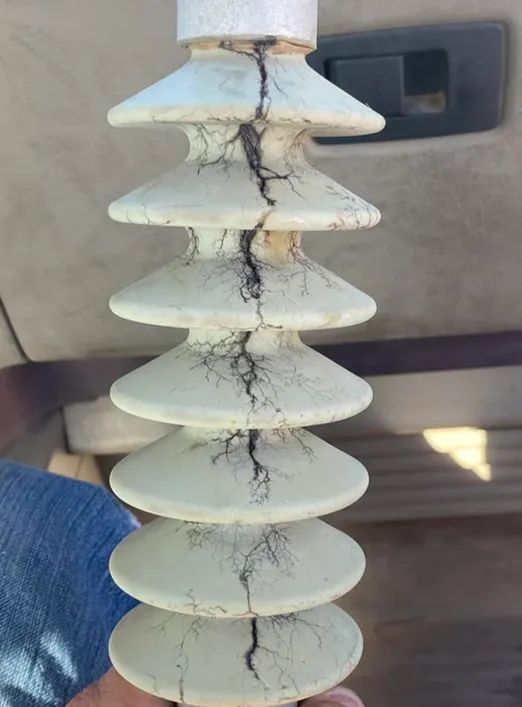
Degrading insulators announce themselves. Partial discharge, the localized electrical activity that both signals and accelerates insulation breakdown, shows up weeks or months before failure. Surface discharge is the dangerous one: it carbonizes tracks across the insulator surface, and tracked insulators are at significantly higher risk of catastrophic flashover. Often, a tracked insulator is only found after a flashover has already started a fire.
Why simple monitoring fails: the environment lies
Temperature, humidity, and barometric pressure all influence partial discharge in non-linear, sometimes contradictory ways. Published research has recorded winter readings over 100 times higher than summer readings on identical equipment, purely from environmental effects. Lab studies conclude humidity suppresses discharge; on aged, contaminated insulators in the field, humidity is a primary driver of the surface discharge that causes flashover.
A monitoring system that ignores this produces false alarms in January and false confidence in July. That is why the research pairs every electrical measurement with real-time environmental data, and trains machine learning models on the combination.
From lab to live lines
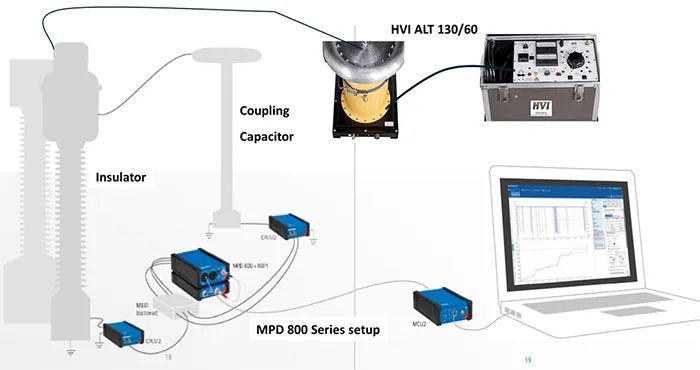
The models were built the slow way. Controlled laboratory experimentation with high-fidelity ultrasonic and RF sensors established labeled discharge signatures. Then field deployment tested them against everything a lab cannot simulate.
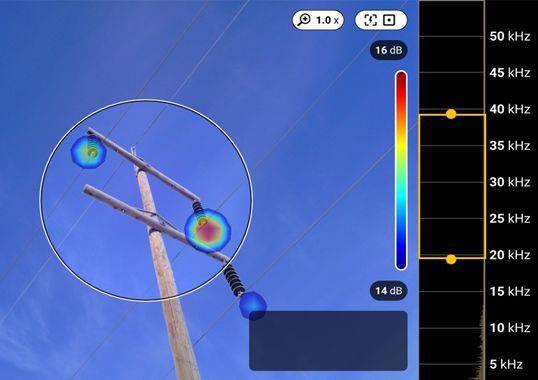
In the field, our pole-mounted Cricket device does the listening: solar-powered, weatherproof from -30°C to +60°C, installed on live structures without de-energization. It captures ultrasonic, RF, and environmental data on continuous cycles, processes at the edge, and transmits over LoRa or LTE. A patent-pending sensor fusion approach cross-references the ultrasonic and RF domains: true partial discharge registers in both, which filters out ambient noise that fools single-sensor systems.
What the field data showed
The paper closes with a case study from live transmission corridors in Alberta: 100 transmission structures and over 50,000 environmental readings.
The headline finding: temperature was a significantly stronger predictor of surface discharge than any other environmental factor, and discharge behavior diverged sharply around freezing, where condensation and ice transform how insulators fail. Statistical testing of four environmental hypotheses produced results that contradict common lab-derived assumptions.
The practical output for a utility is simpler than the physics: a ranked, continuously updated view of which structures are degrading, so the next truck roll goes where the data says it counts.
Detection tells you a line went down. Prediction tells you which one is about to.
Connect with us:
If you're interested in learning how CRWN can predict failures in your assets please reach out to us.